A year ago, the stack of paperwork a Palm Springs condo seller handed over in escrow ran through the usual list: budget, reserves, insurance summary, recent board minutes, notice of any pending litigation. If you bought a unit at La Palme or Canyon Heights in 2024, that stack was the whole story.
This year the stack has a new page in it, and it is not a formality. As of January 1, 2026, California law requires condo sellers to include the association's most recent structural inspection report for balconies, decks, walkways, and stairways in that same disclosure packet. In a city where a large share of the condo inventory was built in the 1950s through the 1980s with exactly the kind of wood-framed, elevated construction that report covers, this is not a paperwork update. It is a new way for a buyer to find out something about a building that used to stay buried until something went wrong.
A New Page In The Escrow Packet
The report itself traces back to a 2019 law, Senate Bill 326, which added Civil Code section 5551 to the Davis-Stirling Act. It required condo associations with three or more units to inspect exterior elevated elements, meaning balconies, decks, stairways, and walkways more than six feet above the ground that are substantially supported by wood. The first inspection was due by January 1, 2025, with no extension, and every nine years after that.
What changed for 2026 is Senate Bill 410, sponsored by the California Association of Realtors. It amended the same section of the Davis-Stirling Act to fold the most recent SB 326 inspection report directly into the standard Civil Code section 4525 disclosure package that every condo seller in California already has to assemble. The report now has to open with a summary page listing the inspection date, the total number of units, how many units have elevated wood elements, how many elements were inspected, and whether any were flagged as an immediate safety threat. That page has to be handed to a buyer before the deal closes, not requested, not buried in an appendix, handed over.
The legislative analysis on SB 410 spells out why this matters for financing as much as for safety. A structural issue flagged in that report can be enough to disqualify a unit from a conforming loan under Fannie Mae or Freddie Mac guidelines, which pushes a buyer toward more expensive financing or no financing at all. For a seller, that risk now shows up in escrow instead of showing up as a surprise after close.
Why This City Has More Skin In This Game
Some California cities will feel this change lightly. Palm Springs will not be one of them.
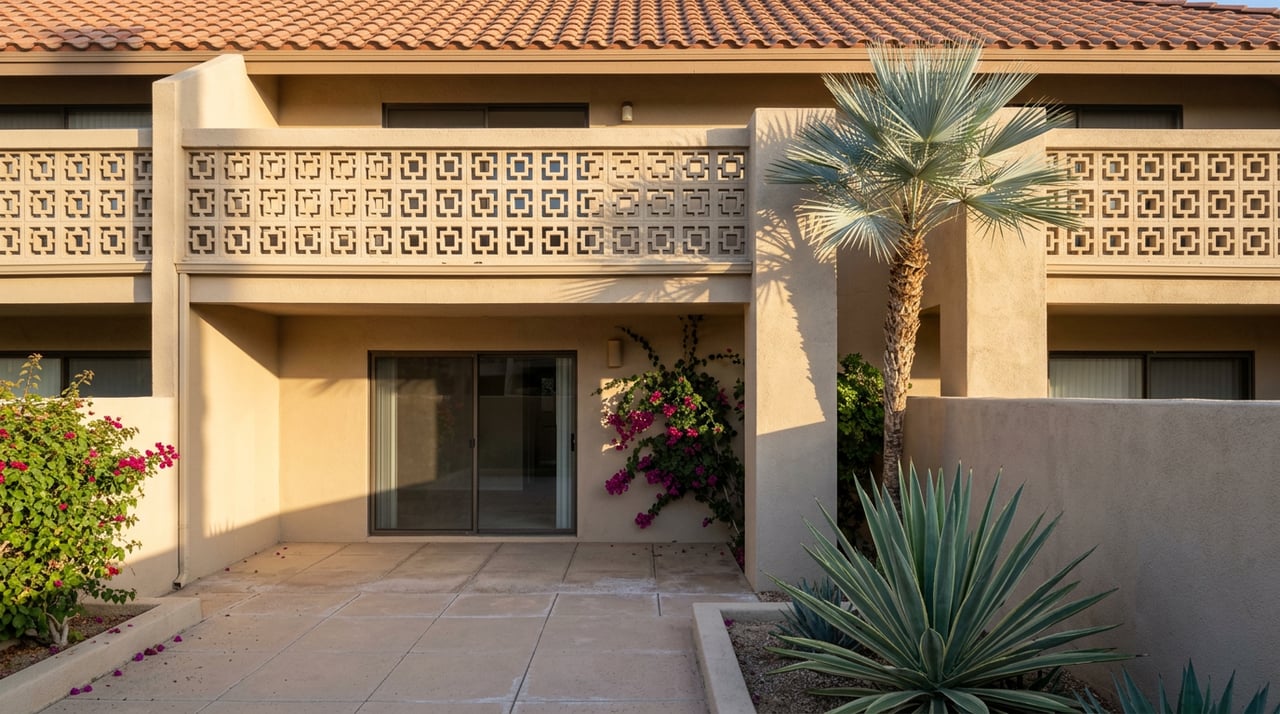
The condo stock here is unusually concentrated in the era this law was written for. Communities like Ocotillo Lodge, Seven Lakes Country Club, Canyon View Estates, Racquet Club Garden Villas, and Park Imperial North and South were built through the 1950s, 60s, and 70s by architects whose names now sell the units themselves: Donald Wexler, William Krisel, William Cody, Hugh Kaptur, A. Quincy Jones. These are low-rise, two-story garden complexes with private balconies and open-air walkways connecting units, built with the wood-frame construction standard of their decade. Newer developments like La Palme, built in 1985, follow the same basic layout: second-floor units with private balconies over the pool.
Canyon Heights, a 93-unit fee-simple community in South Palm Springs, is a good example of what buyers are actually looking at. Its two-story residences include loft-style upper levels opening onto private balconies, with HOA dues running around $902 a month. Palm Springs Country Club, a William Cody-designed community with dues closer to $695 a month, has the same two-story layout with upstairs primary suites reached by interior stairs and private patios below. These are exactly the structures Civil Code section 5551 was written to cover, and until this year, whether any given building had completed its inspection was information a buyer had to think to ask for.
| Community | Land Tenure | HOA Dues (approx./month) | Listing Range Seen | Elevated Wood Features |
|---|---|---|---|---|
| La Palme (built 1985) | Leased land, private ground lease running to 2071 | ~$475 | $350,000–$420,000 | Private balconies over the pool |
| Canyon Heights | Fee simple | ~$902 | $619,000–$999,000 | Two-story units, loft-level private balconies |
| Palm Springs Country Club | Fee simple | ~$695 | $355,000–$450,000 | Two-story units, upstairs suites and patios |
Three condos in the same price band, three different land arrangements, three different buildings that either did or did not complete an inspection that is now sitting in the buyer's hands before the ink dries.
The Number Nobody Puts On The Listing Sheet
Here is the part that changes how a buyer should read a Palm Springs condo listing this year. Industry reporting following the original January 1, 2025 deadline estimated that more than one in five California condo associations missed it entirely. There is no state agency actively auditing associations for compliance, and no automatic fine attached to a late inspection. The consequence was mostly invisible until SB 410 put the report itself into the disclosure file.
That means a buyer opening the section 4525 packet on a Palm Springs condo this year might find a completed report showing a clean bill of health, a completed report flagging repairs the board still needs to fund, or no report at all because the association never finished its inspection. All three outcomes are legally disclosable now. All three carry different weight with a lender, different weight with an insurer, and different weight in how comfortably you can picture yourself owning the unit next year.
A listing price has never told a buyer which of those three situations they are walking into. It still doesn't. The disclosure packet does, and for the first time, the law requires it to say so plainly.
For Downsizers And Estates, The Timeline Matters As Much As The Price
If you are moving from a larger home into a lower-maintenance Palm Springs condo, or you are an executor working through a trust that includes a condo unit, this new page in the packet changes your timeline as much as your risk.
A standard inspection contingency typically runs about seventeen days. HOA document delivery runs on its own clock, and if the association has to track down or update its balcony inspection report before it can hand it over, that clock can push back the date you were counting on for removing contingencies. For someone selling a condo out of a trust or an estate, this is worth flagging early. Executors are often managing a property they did not live in and may not have quick access to board minutes or reserve records. Requesting the section 4525 packet, including the inspection report, on day one rather than after an offer comes in gives everyone more room to work through what it says before a deadline is bearing down.
For a downsizer buying into one of these communities, the practical move is simple: ask for the report before you write the offer, not after. If the association hasn't completed one, that absence is itself disclosable information, and it is worth understanding what the board's plan is before you commit.
The Other Variable Still Hiding In The HOA File
The inspection report is new. The rest of what makes a Palm Springs condo purchase harder to read from the outside is not.
La Palme sits on leased land, with a private ground lease currently running to 2071 and an annual land payment layered on top of the monthly dues. Canyon Heights and Palm Springs Country Club sit on fee simple land, meaning the buyer owns the ground under the building outright. Two units priced within a few thousand dollars of each other can carry entirely different long-term cost structures depending on which side of that line they fall on.
HOA dues themselves vary widely for reasons tied directly to the desert. Monthly fees across Palm Springs condo communities commonly range from around $300 for a basic single-family-style HOA up toward $1,500 or more for a guard-gated country club property, and the gap is driven largely by the cost of heating community pools through the winter and irrigating landscaping through the summer. None of that shows up in a median price headline either. It shows up in the reserve study and the budget, the same file that now also carries the balcony report.
A Few Straight Answers
Does this apply to a single-family home in a Palm Springs HOA community? No. The inspection and disclosure requirement applies specifically to condominium projects and common interest developments with three or more attached units that have qualifying elevated wood structures. A detached single-family home governed by an HOA is not covered.
What if the association never completed its inspection? The absence of a report is not a loophole. It becomes part of what the seller has to disclose, and a buyer's agent reviewing the packet should treat a missing report as a question worth answering before removing contingencies, not after.
Is this the same rule that applies to apartment buildings? No. Rental apartment buildings fall under a related but separate law, Senate Bill 721, which had its own deadline extended to January 1, 2026. Condo associations fall under Senate Bill 326 and its 2025 update, Senate Bill 410, and their original inspection deadline was never extended.
Where This Leaves You
None of this makes buying or selling a Palm Springs condo harder than it used to be. It makes the risk visible earlier, which is a better place for it to live than in a surprise special assessment two years after closing. Whether you're comparing a leased-land unit at La Palme against a fee-simple two-story at Canyon Heights, or you're an executor trying to move a trust property through escrow without losing weeks to a document request, the smart move is the same: ask for the section 4525 packet, including the balcony report, before you're locked into a timeline.
If you're weighing a Palm Springs condo purchase, sale, or trust transfer and want a second set of eyes on what a specific HOA's disclosure file actually says, Charles Estates is here to help you read it before you sign anything. Let's Connect.